



The Limelight District Is the Next Cool Place to Live
Sarasota’s hot new neighborhood is having an identity crisis. What is it even called? The Limelight District? Park East? North Sarasota? What are its boundaries? Do people really live there? Isn’t it all light industry? Whatever its name finally settles down to be, it’s becoming the hip new place in town.
We’re talking about the area with Fruitville on the south, Lime Avenue on the west, 17th Street on the north, and Tuttle Avenue on the east, allowing
for exceptions.
It has always been something of a mystery, serving as a sort of staging area for the rest of the town. It’s the place you go to buy new tires, pick out some granite for your kitchen countertops or take your rug for a shampoo.

Image: Everett Dennison
You glimpse modest houses and condos as you drive up Lime Avenue, but people don’t really seem to live here. It’s not very pretty or prosperous looking—small industrial buildings, unkempt side roads, lots of chain link-fence. Right in the middle is an inexplicable no man’s land—big open spaces with piles of dirt and slabs of concrete. Mysterious puddles. That’s it.
That may not be pretty, but it is authentic in a very artistic way. Art is often created in places like this. It’s what SoHo in New York used to be like. All big cities have gritty places like it. Toiling away in industrial surroundings is part of the artistic process.
For the past five or so years, the area has been defining itself. An arts district has formed. So has a design district. It’s full of unusual shopping. It’s proudly LGBTQ-friendly. It has the best condo prices in town. And can you believe it? Nowhere to eat.
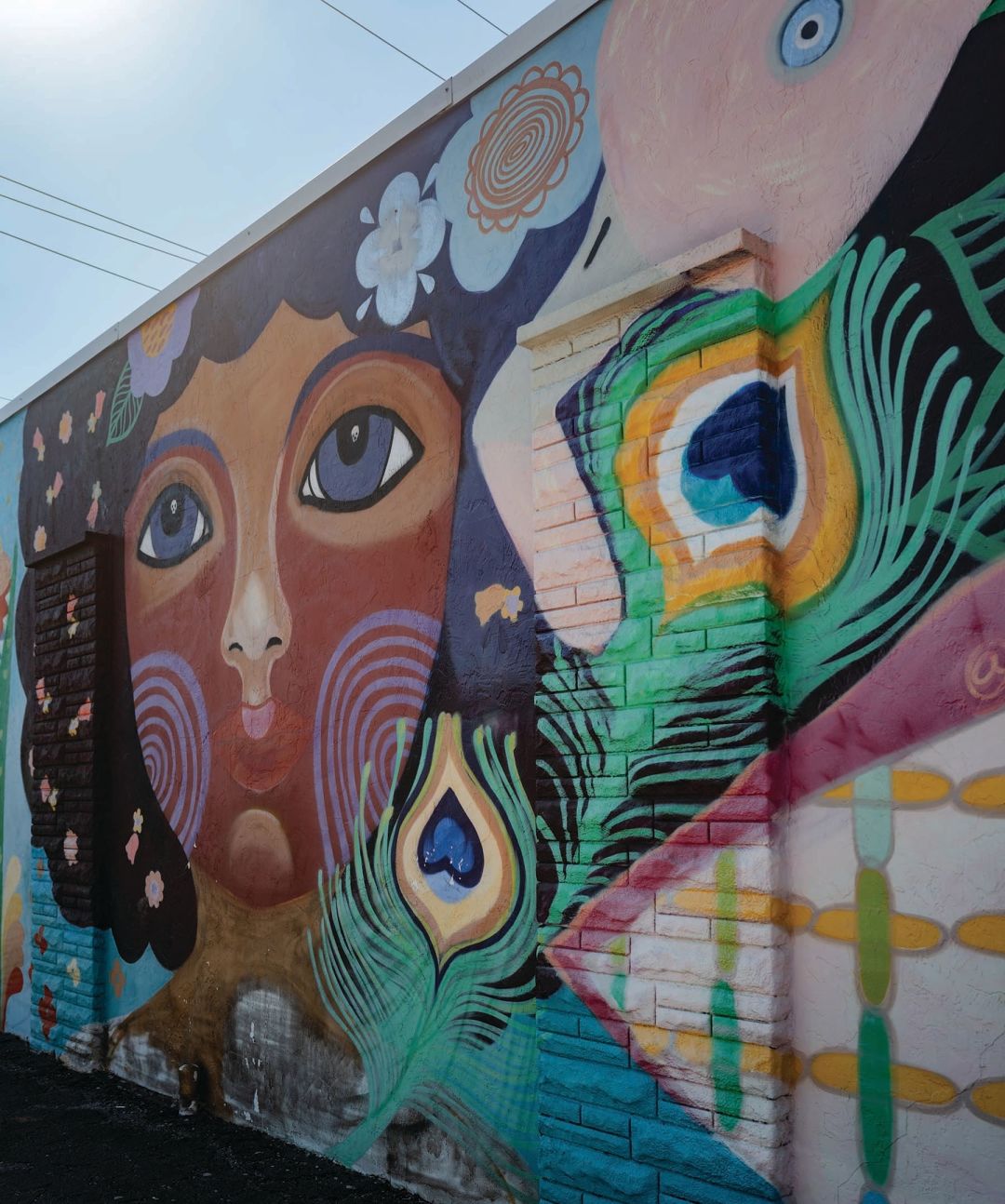
Image: Everett Dennison
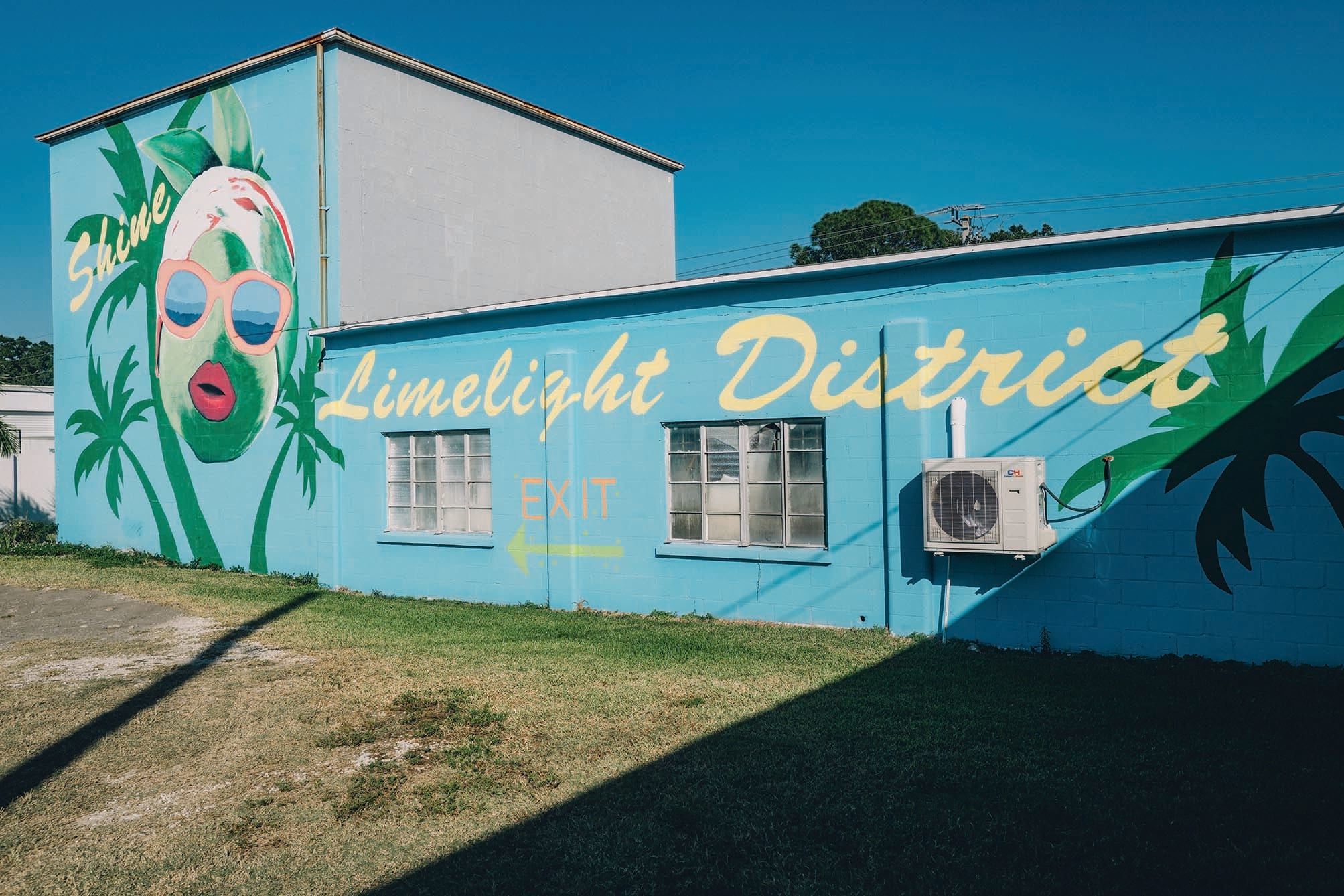
Let’s settle on the name Limelight District. After all, Limelight is the name given to it by the catalyst that brought together the gallery and shopping area that is the commercial heart of the area. It’s the brainchild of Kim Livengood, who co-owns with her mother, Judy Alexander, the colorful Bazaar on Apricot & Lime. The bazaar is a sort of arty flea market, with 40 or so vendors. They’re here because they have a passion for what they do, whether it’s painting, making jewelry or sculpting dogs wearing bikinis.
To solve the food problem, Livengood brought in a food truck. Hamlet’s Eatery is part vegetarian, and it’s presided over by Mitch Rosenbaum (aka Chef Mitch) who’s worked at some of the fanciest restaurants in town. It’s a quirky paradox that defines the Limelight District perfectly—the best restaurant is a food truck.
Hamlet’s is located in the Bazaar’s courtyard, which has developed into a perfect little community space, with live music on Saturdays. There are many co-sponsored events. The Parrotheads come for Jimmy Buffett events; your granddaughter can get a princess makeover; the Players community theater has done plays here. They’ve had vintage fashion shows and even a Young Entrepreneur Day where the vendors are kids.

Image: Everett Dennison

Image: Everett Dennison
Nearby are several spaces where artists work and sell. At Creative Liberties, with two locations just steps from the Bazaar, you’ll find the work of a variety of local artists. Then head over to SPAACES on Princeton Street. A dozen or so artists work in these large storage unit-type studios, run by Marianne Chapel. The painters are all professionals, with advanced degrees and teaching credentials. (Note: The artist spaces are not always open when they say they are. Check first.)

Image: Everett Dennison
Now let’s go for a little drive around the neighborhood. It isn’t easy. Many streets are segmented, and a few aren’t even paved. The railroad tracks, mostly disused, run right through it, and there’s that aforementioned area at the center, which is mostly vacant. To me, it looks like picturesque urban decay, though I’m sure a lot of other people see dollar signs.
A beautiful new showroom for Monogram cabinets just opened on Lime, and a prominent downtown restaurateur has bought the old Mr. Florist building and plans to bake all his bread here. Mark Vengroff, the visionary affordable housing guy, is said to be planning something where the old Stottlemyer & Shoemaker Lumber Co. yard used to be. I hear there was also a plan to turn the area’s only trailer park, Friendship Village, into an assemblage of hip, stylish tiny houses. But for now, the neighborhood remains a visual essay in industrial architecture—silos, warehouses, fuel tanks, metal roofs and blank facades.
It’s also home to light manufacturing. This is where the town’s high-end kitchens are built. You can get body work done, on both you and your car. Up on 17th Street is a little recording studio where the Allman Brothers worked. You can even find God at the Deliverance Miracle Revival Center.
You’ll also see a couple of spectacular architectural wild cards, like the Resource Factory on 12th Street. It’s got to be Sarasota’s only steampunk building. (The Factory, I am told, manufactures enormous statues of characters like SpongeBob SquarePants for public spaces all over the world.)

Image: Everett Dennison
This part of Sarasota also has a special connection to dogs and cats. The Humane Society is on 15th Street, and you can hear the dogs barking for blocks. Just out of earshot, thank God, is Cat Depot on 17th, probably the town’s leading cattery. You’ll also find quite a few doggie daycare centers. And when it’s finally time to say goodbye, there’s even a pet crematorium over on Princeton Street.
You wouldn’t think of the neighborhood as a place to shop, but it has the best used furniture in town. Braden River Antiques, on East Avenue, is run under the curatorial eye of Jess Sturtevant and features high-end midcentury classics. Check out the pair of black-and-gold chests by Dorothy Draper and the Hollywood Squares wall of incredible classic chairs. This is where I found a painting by Dorothy MacDonald, wife of famed crime novelist John D. MacDonald. I hung it over my writing desk in hopes I will produce as much money as John D. did when it hung over his.

Image: Everett Dennison

Image: Everett Dennison
Next door is Hudson Mercantile, run by Chris Hebert. He was originally up in New York’s Hudson Valley; now he’s down here with a store full of great stuff, similar to Sturtevant’s inventory. (Some people complain the stores aren’t open when they should be, so call first.)
Lime Avenue’s claim to being a design district is strengthened by several other shops a few blocks to the north. There’s Sarasota Antique Buyers, at 1502 N. Lime, with a wide variety of items, including many “smalls,” as they’re known in the trade—statues, boxes, candlesticks, etc. Next door is Personalized Estate Liquidation Benefiting Youth (PEL), which has estate sale furniture—good, solid, classic stuff at good prices. It’s rather like walking into an enormous Park Avenue living room circa 1960.
But don’t buy that couch before checking out ReStore, the Habitat for Humanity store on 17th Street. It’s by far the best Habitat store in the area, not too big but full of wonderful, high-quality furniture. The better pieces can go for over a thousand dollars, but you’ll also find bargains.

Image: Everett Dennison

Image: Everett Dennison
And to round out your shopping, drop by Canned Ham Vintage at 2801 12th St., generally considered the best vintage store in town. There’s furniture here, mostly smaller pieces that are cute and kitschy. But the real attraction is the clothes and accessories. The emphasis is on quality and uniqueness—I have my eye on a Pierre Cardin shirt from the ’60s, priced at $65.

Image: Everett Dennison
That was a lot of shopping. Let’s get something to eat. I suggest a stop at the Sunflower Market at 200 N. Lime, Sarasota’s oddest supermarket. It’s like wandering into one of those supermarkets in Italy, where everything looks different and enticing but a little hard to figure out. Here the gimmick is that they sell foods that have passed their “use by” date, which means row after row of cans and jars from all over the world. Sunflower is especially strong on snacks, and I’ve tried a bunch. Those caramels from Denmark were a little greasy, but, boy, were they good. And they only cost a dollar.

Image: Everett Dennison
To paraphrase pop star Katy Perry, “I want to live in the Limelight District, said no one ever.” It’s a place you just don’t think of living in. It has no image, no real sense of place as a residential neighborhood.
It’s the equivalent of what realtors like to call “a hidden gem” or “best-kept secret.” It’s hard to drive around and look at houses. The segmented streets have created little mini-neighborhoods that don’t connect with each other. But be patient. You’ll find a half dozen areas with older cottages and bungalows that can compete with any other pleasant but modest neighborhood in the city. You can have giant trees, mature vegetation and a lot of privacy, even though you’re in the middle of town.
The problem is that so few of them come on the market. At the moment there are perhaps a half dozen for sale. They are, typically, concrete block ranches from the 1960s, nicely remodeled, but priced at close to half a million—a little expensive for most starving artists.
But apartments and condos are plentiful and offer some of the most affordable living in town. The units really do suit creative types on a budget. Over the years I’ve known perhaps five or six people who lived here. One was a painter, one a stage manager, one a videographer, one an actor and one a waiter who wanted to be an actor.
The eastern edge is where the housing lies, mostly older complexes that have become part of the town’s social history. Take The Palms on Tuttle. Now it’s condos, but back in the old days it was a rental complex known as Club Mar. It’s where everybody lived when they first moved to town—young, ambitious and looking for fun. Its potluck socials were famous, emphasis on the pot.

Image: Everett Dennison
A couple of blocks west, on Jefferson Avenue, are complexes that really do fall into the hidden gem category: Jefferson Pines and Bermuda Park. They offer one-story attached villas just under 1,000 square feet, with two bedrooms and two baths. Most of the units look out onto green space. You won’t have a garage or much storage space, but at just under $200,000, they’re hard to top.
If you think the ceilings are too low to create art, check out nearby Jefferson Club. Here you’ll find the perfect starving artist condo. The ceiling in the main room is vaulted and has a clerestory window. You could actually paint there. Each unit is enclosed by a wooden fence in both front and back for even more light and privacy. The complex is pleasantly eccentric in a way artists will appreciate, and the two-bedroom units are currently going for around $150,000. Let me repeat that—a two-bedroom condo a mile from downtown for 150K.
You’ll be doing a lot of cooking in your new condo as there’s no place to eat but Hamlet’s. “It’s a food desert,” as one resident put it. You’ll find a couple of restaurants at Grand Slam Plaza on Tuttle, and there are a couple of Mexican places that have been there forever, but any sort of restaurant scene has yet to appear. It doesn’t really matter, though. You’re so close to downtown. You can walk to Mediterraneo, as long as you have comfortable shoes and 45 minutes to kill.
Nightlife? Forget it, although there is a craft brewery, Sun King on Mango. Famed New Urbanist city planner Andrés Duany had some interesting things to say when he was here recently and toured the Limelight District. Duany believes that every city needs nightlife. It’s what keeps the young adults and singles here. “They need time and space to sample genetic material and find a life mate,” he says. And the Limelight District?
“It’s perfect,” he says, “and would be edgy in two seconds, with bars, music and dancing.” (For more on Duany’s impact on Sarasota, click here.)

Image: Everett Dennison
Duany’s vision is still very much in the future, but now that the Fab Arts Foundation has relocated to the corner of 12th and Lime, there may be some real genetic material sampling. The foundation is run by Shannon Fortner, who has become, during the past 15 years, the most prominent gay person in town. They put together the successful Harvey Milk Festival (now the Be Fabulous Music & Arts Pride Fest), and they are a strong believer in queer visibility.
The foundation just finished the 15th annual Fabulous Independent Film Festival, and there are several events I’m putting on my calendar. First of all, the weekly crafting group, called “Stitch n’ Bitch,” and then Tea4T, Drag Open Stage, with drag queens of all sorts performing. Patrons are told to bring plenty of cash to tip the performers. That’s my kind of nightlife.
The fact that a queer art center chose Lime Avenue to settle in says a lot about the neighborhood. It goes out of its way to be inclusive, and it really does come across as a safe space as well as an artists’ enclave.

Image: Everett Dennison
Virginia Hoffman, one of Sarasota’s long-term artists, has had a studio here since 1984, when she bought a 2,400-square-foot building right next to the railroad tracks. She’s also a political gadfly, fighting for better zoning, public art and that ordinance that allows each house in Sarasota to accommodate four chickens.
For several years Hoffman lived in her space; there was a clause in the deed that allowed a “caretaker.” Now she lives in Arlington Park, but her creative energy still fills her workplace. “Being in an industrial space inspires me,” she says. “I don’t have to worry about noise. I can have my metal supplies delivered right to the door. I have plenty of freedom to do exactly what I want.”
But Hoffman’s live/work situation is unusual, and you can’t help but feel that area artists should have more options. “I want to see inclusionary zoning that allows live/work and tiny homes,” she says. “And the city needs to get on this sooner rather than later. Like now.”
Sarasota has always been a great town for artists. Back in the 1950s, it was full of arts schools, and well-known painters seemed to be everywhere. What’s happening in the Limelight District is a continuation of this tradition. Imagine—living in a converted shipping container next to a factory that makes 10-foot-high statues of SpongeBob SquarePants.
It would be so cool.