

Did Sarasota Pass or Flunk New Urbanism?

Image: Gene Pollux
The Sarasota Downtown Master Plan 2020, prepared by internationally renowned urban planner Andrés Duany of Duany Plater-Zyberk & Company, was adopted exactly 25 years ago, in January 2001. It promised a city remade through walkable streets, mixed-use blocks and a code that prized human scale over parking ratios—a comprehensive manifesto for how Sarasota could grow up without growing apart.
At the time, Sarasotans were elated. Duany—the sharp-tongued co-founder of the New Urbanist movement—had arrived with a vision for transforming a low-slung Gulf Coast city into something more cosmopolitan, coherent and urbane. Local officials called his hiring a coup. Civic boosters envisioned café tables on shaded sidewalks, ground-floor shops buzzing after dark, and a downtown area stitched back to the bay and adjacent neighborhoods.
Twenty-five years later, the City of Sarasota is once again poring over that same playbook. The city’s planning department has begun the process of updating Duany’s 2001 master plan, an acknowledgment that the city has, in many ways, outgrown its early-millennium draft—and in others fallen short of it. The review raises the question: After all this time, has Sarasota realized the New Urbanist ideal, or paved over it?
We selected seven of the 2001 Downtown Master Plan categories that we believe had the most significant impact on us and asked our readers to complete an online survey sent out in our newsletters, and on social media, to answer the question: “Did Sarasota pass or flunk New Urbanism?”
And you answered. We heard from 258 commuters, visitors, downtown Sarasota business owners and residents. We tallied points based on readers’ answers, which determined each category’s letter grade.
As much as we love our downtown, summa cum laude is out of reach. Not a single category received anything above a “C.” But we also know that criticism is a measure of how much people care about this place and want it to improve—and that’s a good thing.

Image: Everett Dennison
Walkability and Streetscape: C
Duany called downtown’s streets “too wide and unpleasant to walk,” noting that many blocks lacked continuous sidewalks or shade. His fix: narrow the lanes, fill in missing walkways, and connect the bayfront and cultural core with safer, tree-lined routes.
Housing Diversity and Affordability: D
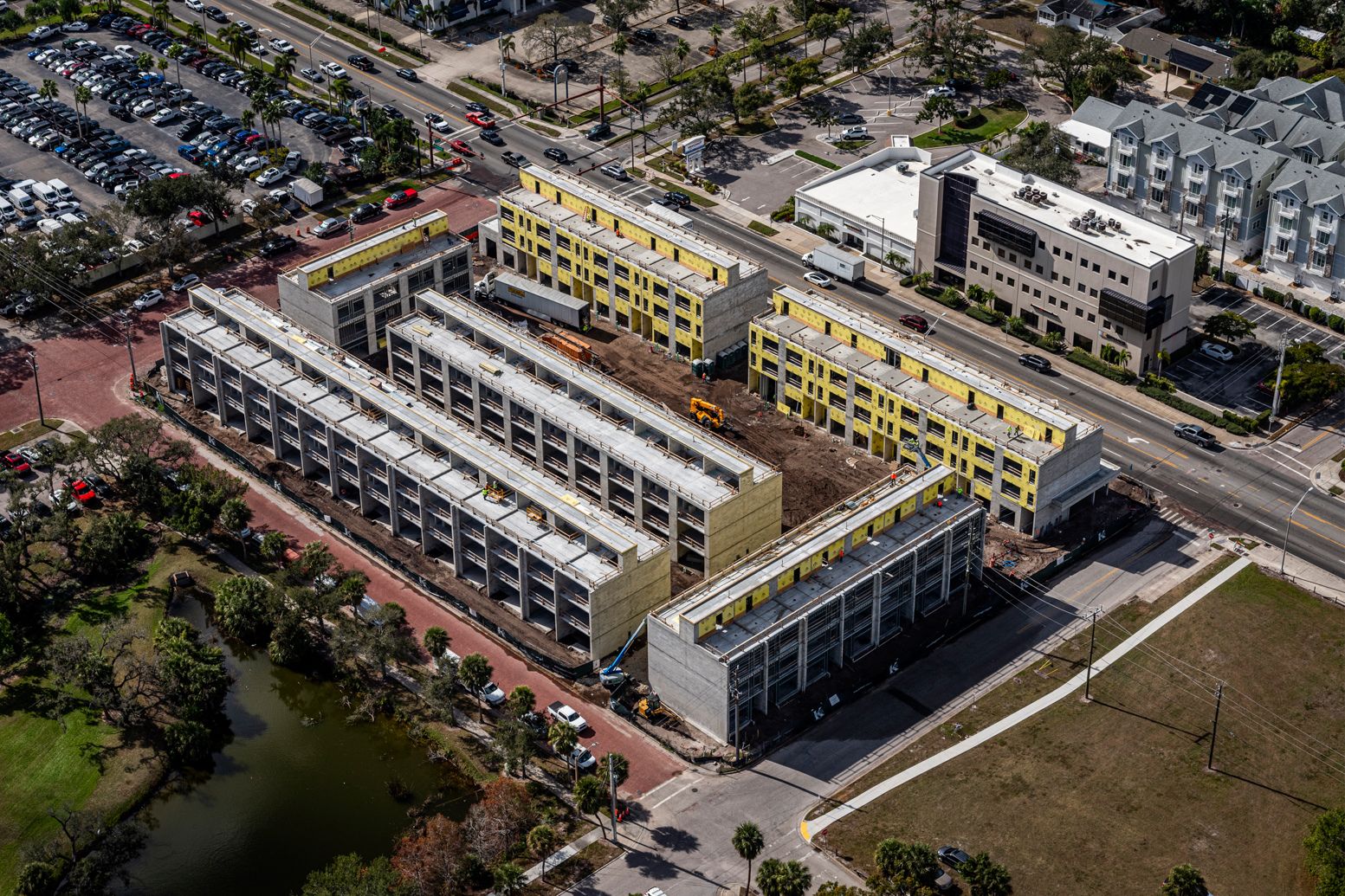
Duany imagined a mix of incomes and housing types downtown. Two decades later, luxury dominates. Since 2001, the Rosemary District alone has added more than 1,500 upscale units, with plenty of pricier condos still on the way in the downtown core. The city’s attainable-housing push has helped, but not enough to balance a market tilted hard toward high-end buyers.

Image: Everett Dennison
Civic Life: C
Duany wanted Sarasota to feel like a city of gathering places, with plenty of spaces for people of all ages and abilities. The redesigned Lemon Avenue and Paul N. Thorpe Jr. Park corridor and the opening of The Bay in 2022 have brought that to life. Still, Fruitville Road—the divide Duany once called “too wide, too fast, too hostile”—remains a barrier between downtown and the neighborhoods to the north.
Mixed-Use Urban Development: C
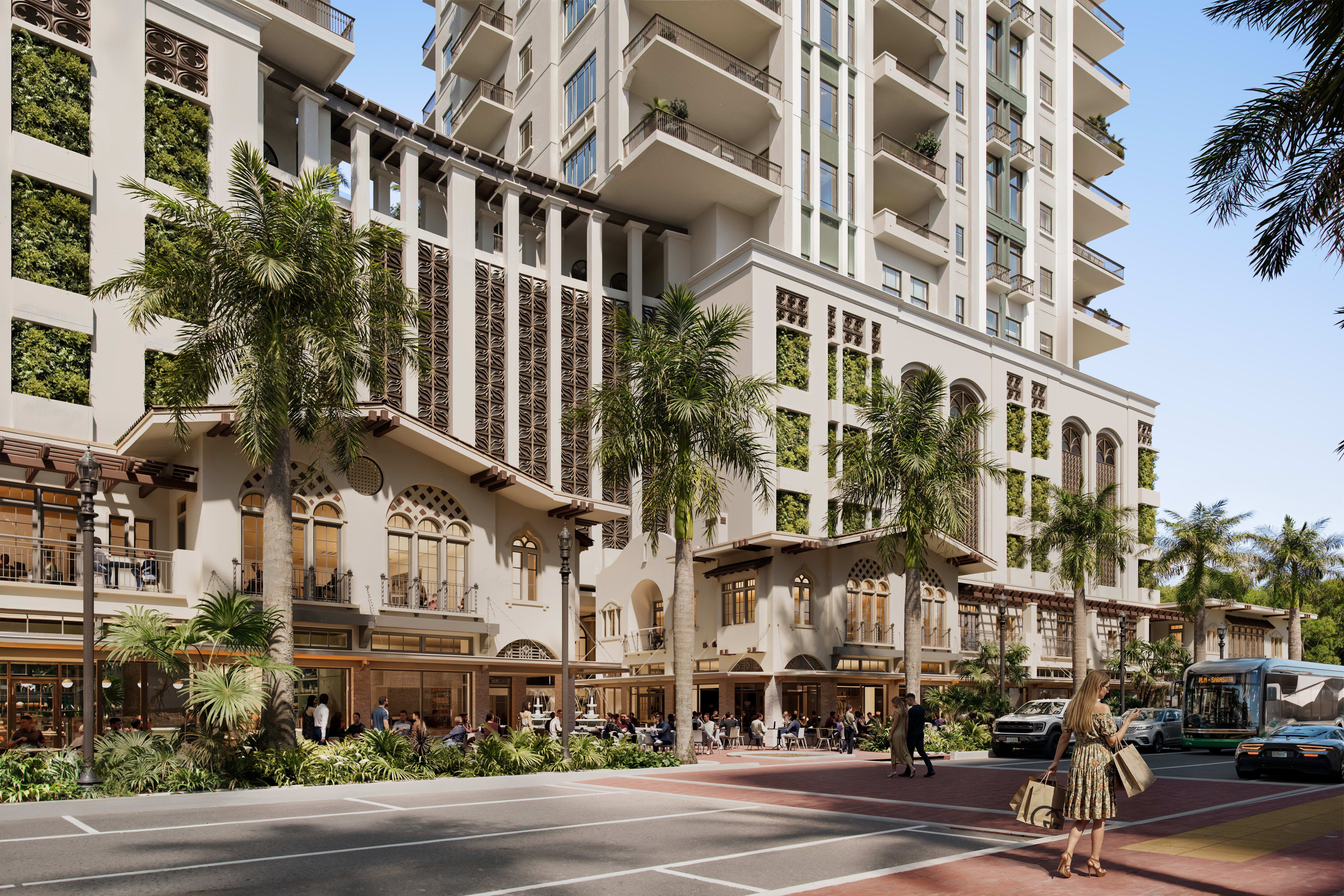
Downtown should function like a real neighborhood—places to grab coffee, run errands and live your life all within the same few blocks. That meant ground floors filled with active uses and upper floors stacked with homes and offices to keep the area busy well past business hours. Sarasota has made strides in this direction. The Quay’s early blocks mix restaurants with apartments, and The Mark brought people living directly above shops on South Pineapple Avenue. But the day-to-day rhythm is inconsistent. Some storefronts are vibrant, others sit dark or become bank branches and leasing offices, creating long quiet stretches where Duany imagined a steady hum of activity. The ingredients exist, but the block-by-block energy is still uneven.

Image: Everett Dennison
Architecture: D
In Duany’s master plan, architecture wasn’t about style—it was about shaping the public realm. His form-based code set out rules for how buildings should hold the street corners, step back as they rise, and create a comfortable space—a “room”—for pedestrians with shade and openness. The goal was a downtown that felt coherent and proportional, even as it grew taller. The reality is uneven. Some recent buildings respect those proportions, but others break the spell.
Transit and Mobility: D
Duany envisioned a downtown where getting around didn’t require sitting behind a windshield. Sarasota in Motion, adopted in 2020, nudged the city in that direction with new sidewalks, bike connections and safer crossings—most notably at the U.S. 41 and Gulfstream roundabout. But the bigger shift never arrived. Bus service is limited, routes are infrequent and the dedicated transit lanes Duany would have celebrated never materialized. For most people, a car is still the default.
And while biking has grown in popularity, it’s hardly carefree. Sarasota County has ranked among the most dangerous counties in Florida for cyclists, with an estimated 5.5 cyclist deaths per 100,000 residents in recent years—well above national averages. Pedestrians face similar risks: the Sarasota-Manatee region records roughly two dozen pedestrian deaths a year, and nearly one-quarter of all fatal crashes involve someone on foot.
A few roads stand out as especially tough for anyone not in a car. U.S. 41 remains wide, busy and fast-moving through downtown; Fruitville Road continues to prioritize speed over crossing comfort; and U.S. 301 at Gillespie Park still challenges walkers and riders. Sarasota is safer than it was in 2001, but for anyone on foot or on two wheels, the city still feels like a work in progress.

Image: Everett Dennison
Neighborhood Connections: C
Duany wanted downtown to knit naturally into the neighborhoods around it, so that walking from Main Street into the Rosemary District, Gillespie Park or Park East felt like a gentle shift, not a hard boundary. Some of that stitching has begun: new housing and cafés in the Rosemary District have pulled more people north, and improvements along Boulevard of the Arts have created a clearer east–west spine. But Fruitville Road continues to feel like a dividing wall and older barriers linger, too, like the wide, fast stretch of U.S. 301, which makes crossing between Park East and downtown feel more like darting across a highway than entering an adjacent district. The result is a downtown that’s expanding, but not yet fully connected to the neighborhoods that frame it.
Here’s How We Calculated the Grades
We assigned points to each letter grade (A=5, B=4, C=3, D=2, F=1), then averaged these points to arrive at the overall score, which corresponded to the letter grades. Each category received at least some “As” and “Bs,” but respondents overwhelmingly wanted the city to do better. Under this formula, “Walkability and Streetscape” received the highest average grade (a solid “C”), while “Housing Diversity and Affordability” was the lowest (a “D-”).
3.37: Walkability and Streetscape | 1.99: Housing Diversity and Affordability | 3.29: Civic Life and Neighborhood Connections | 3.18: Mixed-Use Urban Development | 2.68: Architecture | 2.85: Public Transportation and Mobility | 3.10: Neighborhood Connections

Image: Everett Dennison
Our Readers Respond
Some comments have been shortened for length and clarity.
“There are many pluses to the realization of the urban plan: Downtown is beautiful and walkable, [and] it’s much more lively than it was 20 years ago, and it’s connected to the waterfront. However, it is expensive and inaccessible to about half of Sarasota County residents.”
- “We need fewer cars downtown.”
- “The Bay is fantastic, and one of the reasons I don’t move away from downtown.”
- “Downtown has become beautiful but out of reach—a place for the rich, not the rest of us.”
- “The city is developing nicely. Some great projects are coming to the urban core. I absolutely love living here and being part of the growth.”
- “We need more green space and fewer zero-lot-line high-rises.”
- “Downtown is much better and livelier than 25 years ago, but unaffordable for the young and low-income.”
- “More streets should have bike lanes. Bus stops should be lit at night.”
- “Crossing Fruitville, the bayfront, and Tamiami [Trail] is literally an accident waiting to happen. Ideally, there would be an elevated skybridge for these dangerous crossing points.”
- “Although many complain about the high-rise buildings all growing in downtown Sarasota, I think the downtown area is very charming.”